
2025 A Year of Transformation, Challenge, and Pragmatic Hope
2025 A Year of Transformation, Challenge, and Pragmatic Hope explores change, resilience, and realistic optimism shaping decisions and growth

Continuous Improvement
·
May 18, 2021
For-profit or not-for-profit? Is that the question? Perhaps not! All organisations need to make a profit over a sustained period...
For-profit or not-for-profit? Is that the question? Perhaps not!
All organisations need to make a profit over a sustained period. Without profit, an organisation will be restricted, and eventually cease. We'd probably laugh if we called organisation 'For-Loss' or 'For-Breakeven-Only'.
A more relevant question is: 'How should organisations distribute profit?'
This is an important question which impacts millions of Australians. At least 10% of Australian organisations are not-for-profit (NFP). That's at least 250,000 NFPs! If each of these organisations positively impacts just 10 people per year, that would mean 2,500,000 people would benefit.
The real numbers are much higher!
On the surface the difference between For-Profit and NFP appears obvious.
"Not-for-profit (NFP) organisations are organisations that provide services to the community and do not operate to make a profit for its members (or shareholders, if applicable)." (ATO)
And these ultimately requires profit. Profit enables the following outcomes to be achieved:
In fact, NFPs may have an advantage over other organisations. Their profits are retained rather than distributed as shareholder dividends. Business leaders within NFPs may understand this and focus on social impact. However, an insufficient number of NFP employees appreciate this.
The following diagram highlights the differences between 'For-Profit' and 'NFP' organisations. Depicted in this way, similarities are emphasized rather than differences.
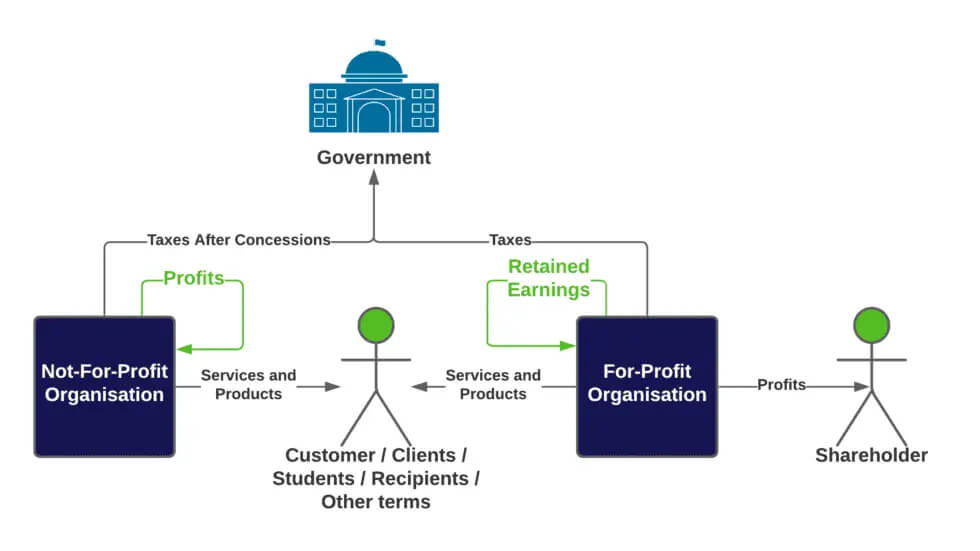
Simon Sinek encourages us to adopt the terminology 'For-Impact Organisation' and to recognise that businesses don't exist to make money. Instead, they exist to accomplish something, to advance a greater cause, to contribute to society. Money is fuel to any organisation - whatever their tax delineation.
Sinek also highlights that shareholder supremacy, short-termism, and high incentives for executives are more recent phenomenon which undermine organisations and their impact.
So, what can organisations learn from all this?
For-Profits can learn to:
Not-For-Profits can learn to:
Government executives and staff can become more effective with:
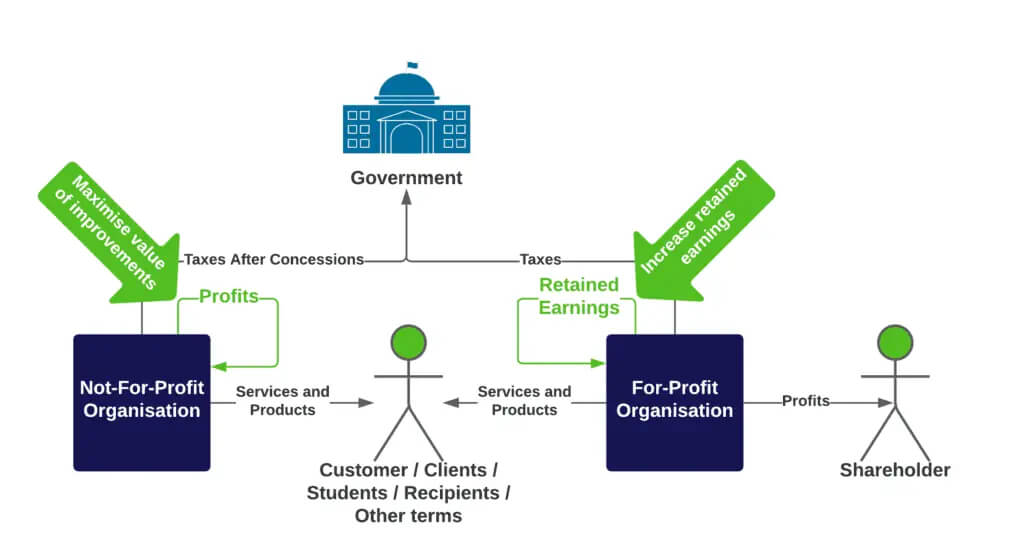
The diagram below highlights a new focus for NFPs/For-Impact and For-Profits.
Finally, let's do what we can to maximise the value we provide to our customers, clients, employees, and the broader community. Wishing you success!
2025 A Year of Transformation, Challenge, and Pragmatic Hope explores change, resilience, and realistic optimism shaping decisions and growth

Explore why Australian productivity fails and uncover the key factors affecting efficiency, growth, and workplace performance today.

Learn to avoid common pitfalls with The Resourcing Trap and discover strategies to optimize resources and achieve better results.